contributed by Ryan Schaaf & Jack Quinn
Everybody enjoys games.
Albert Einstein himself suggested they are the most elevated kind of examination. He understood games are opportunities for something much deeper and more purposeful than a childlike wild-goose chase. Games promote based discovering, or in other words, learning that occurs in groups of method throughout immersive experiences. Often, playing games are the first method kids utilize to explore higher-order reasoning abilities connected with producing, reviewing, assessing, and using brand-new expertise.
See also 50 Inquiries To Help Trainees Consider What They Assume
This post is composed in two components. The first, written by Ryan Schaaf, Aide Teacher of Modern Technology at Notre Dame of Maryland University, introduces gamification in an academic context, its many elements, and some products that imitate gamified methods. The 2nd part, shared by class instructor and instructor Jack Quinn, provides a firsthand account with perspective from a gamified discovering specialist. Below are our mixed insights.
Gamification In An Educational Context
Gamings have many elements that make them powerful lorries for human discovering. They are commonly structured for gamers to resolve a trouble; a vital ability needed for today and tomorrow. Numerous games advertise interaction, participation, and also competition among gamers. A few of the most immersive video games have an abundant story that generates imagination and imagination in its gamers. Lastly, depending upon how they are created, games can both teach and check their players. They are unbelievable bundles of mentor, learning, and analysis.
The structural aspects of games are likewise especially fit to serve this current generation of students. Commonly referred to as gamification (or gameful style according to Jane McGonigal), this approach of including video game elements such as storytelling, problem-solving, aesthetics, guidelines, cooperation, competitors, incentive systems, responses, and learning through trial and error right into non-game scenarios has currently skilled extensive implementation in such areas as advertising, training, and consumerism with rampant success (see http://www.cio.com/article/ 2900319/ gamification/ 3 -enterprise-gamification-success-stories. html) for more information.
In the education and learning realm, gamification is starting to get heavy steam. With success tales such as Classcraft, Class Dojo, and Rezzly leading the cost, the capacity for gamification to infect more and more classrooms is a forgone verdict. There are additionally pockets of teachers in the teaching landscape that are creating their own ‘gamefully-designed’ learning settings. The next area explores such an environment by sharing Jack’s experiences with his very own course.
See also 10 Specific Ideas To Gamify Your Class
Gamification: From Theory to Practice
I have been included with gamification for fairly some time now. In my 9 years of experience, I have actually found video games are fantastic at dealing with several usual class concerns such as: trainee participation/talk time, pupil engagement, distinction, data tracking, and enhancing pupil success.
As an ancillary language instructor on Jeju Island in South Korea, gamification helped me enhance student talk time by 300 %. My 250 trainees completed over 27, 000 ‘quests,’ a.k.a. additional homework jobs they chose to do. My top 10 % of individuals spent an hour outside of course speaking their target language daily. I was also startled on greater than one event to get here very early to work and locate my students had beaten me there and were excitedly awaiting my arrival so they might begin their everyday quests.
As a classroom teacher in the Houston Independent School area offering institutions with a 95 % complimentary and reduced lunch populace, I have taught both 3 rd- quality analysis and 5 th- quality science. Each of these is a state-tested subject (that I taught for 2 years).
Usually in my first year of guideline, my pupils have done 1 39 times the district norm and 1 82 times the district norm in my second year showing the subject. Or put another way, traditional approaches would certainly take 14 to 18 months to accomplish what I can do with games in 10
I credit much of this success to complying with the recommendations of Gabe Zicherman from his Google Tech Talk, Enjoyable is the Future: Understanding Gamification , where he advises game developers to “incentivize whatever you want individuals to do.” (Zicherman, n.d.)
Therefore I aim to determine the essential activities my trainees need to exercise then build video games and benefit systems around those activities.
Gamification in education utilizes the auto mechanics of games– factors, levels, competition, difficulties, and incentives– to encourage trainees and make learning more engaging. Below are 20 practical, classroom-tested examples of gamification that instructors can utilize to boost motivation and engagement.
1 Offering Factors for Meeting Academic Objectives
Do students need to mention information from the message and assistance final thoughts with proof? Honor 1 point for an answer without evidence, 2 factors for one piece of evidence, and 3 factors for numerous items of evidence. This makes evidence-based assuming measurable and encouraging.
2 Giving Points for Procedural or Non-Academic Goals
Intend to shorten the time it requires to examine research? Honor 2 points to every pupil that has their exercise before being triggered. This gamifies treatments and urges self-management.
3 Creating Spirited Obstacles or Obstacles
Introduce fun challenges — problems, riddles, or time-based difficulties– that pupils have to get over to open the following action of a lesson. These obstacles enhance involvement and mirror the challenge-reward loop in games.
4 Developing Healthy And Balanced Competition in the Class
Attempt Instructor vs. Course : Trainees make factors collectively when they comply with policies; the educator makes points when they do not. If students win, compensate them with a 1 -min dance celebration, additional recess, or decreased research.
5 Comparing and Reviewing Efficiency
After a project, offer students with a performance malfunction — badges for creative thinking, teamwork, or determination, plus data like “most concerns asked” or “highest number of drafts.” Representation is a core aspect of gamification.
6 Creating a Variety Of Unique Benefits
Deal tiered rewards that interest different characters. For example: sunglasses for 5 points, shoes-off advantage for 10, a positive parent message for 15, or the right to “swipe” the educator’s chair for the highest marker.
7 Utilizing Levels, Checkpoints, and Development
Track points over several days or weeks and allow students degree up at turning points. Higher levels open advantages, coach roles, or benefit difficulties– mirroring video game progression systems.
8 Grading Backwards
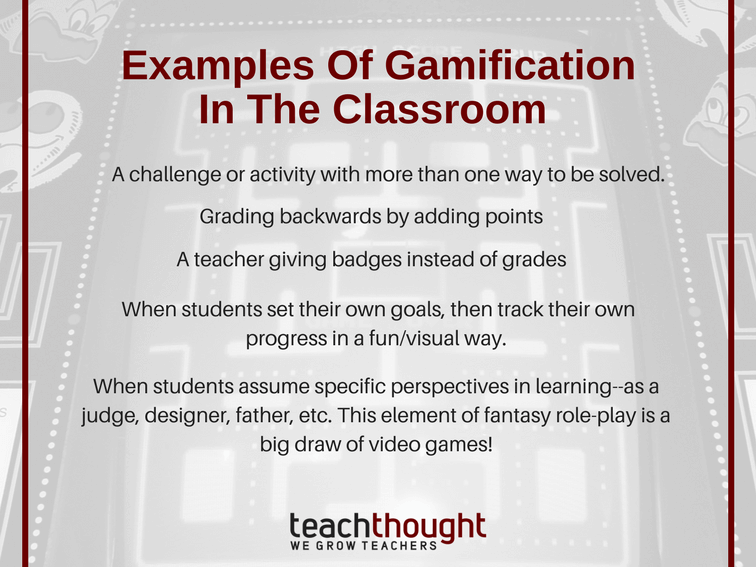
Rather than beginning with 100, let students earn factors toward mastery Each proper response, skill demo, or positive habits relocates them closer to 100 This method reframes learning as development instead of loss avoidance.
9 Developing Multi-Solution Difficulties
Layout jobs with more than one valid solution and urge trainees to contrast strategies. Reward imaginative or distinct remedies to encourage different thinking.
10 Using Knowing Badges
Instead of (or alongside) grades, supply electronic or paper badges for success like “Vital Thinker,” “Partnership Pro,” or “Master of Fractions.” Badges make finding out goals concrete and collectible.
11 Letting Pupils Set Their Own Goals
Permit pupils to establish customized objectives, after that track their development aesthetically on a class leaderboard, sticker label graph, or digital tracker. Self-directed goal-setting is encouraging and instructs ownership.
12 Helping Trainees Presume Duties or Personas
Usage role-play to have pupils act as courts, designers, or historians while working with tasks. Role-based discovering taps into the immersive nature of video games.
13 Classroom Quests and Storylines
Wrap units or lessons in a narrative arc (e.g., “Make it through the Ancient People”) where pupils open new “chapters” by finishing assignments.
14 Time-Limited Employer Battles
End a system with a collaborative testimonial challenge where trainees must “beat the one in charge” (address a set of challenging troubles) before the timer goes out.
15 Randomized Rewards
Make use of a mystery benefit system : when trainees earn sufficient points, let them draw from a reward jar. The unpredictability maintains motivation high.
16 Digital Leaderboards
Produce a leaderboard for cumulative factors, badges, or completed challenges. Public recognition motivates competitive pupils however ought to be framed favorably to prevent reproaching reduced entertainers.
17 Power-Ups for Positive Behavior
Introduce power-ups such as “added hint,” “avoid one research trouble,” or “rest anywhere pass.” Students can spend earned indicate trigger them.
18 Cooperative Course Goals
Establish a shared unbiased — if the whole course fulfills a point total amount, they gain a group benefit like a read-aloud day, a project party, or perk recess.
19 Daily Streaks
Track day-to-day engagement or homework completion with streak mechanics like those made use of by language-learning apps. Damaging a streak resets development, motivating uniformity.
20 Unlockable Reward Content
Offer reward tasks or secret degrees (problems, video clips, enrichment issues) that pupils can unlock after satisfying a point threshold. This gives innovative trainees added difficulties.
Why Gamification Works
Gamification turns regular jobs right into appealing challenges, urges innate and extrinsic motivation, and supplies constant responses. When applied thoughtfully, it advertises mastery, cooperation, and a feeling of progression.
Learn more about gamification in learning , discover game-based understanding techniques , and obtain ideas for raising pupil involvement
Perk: Using a scoreboard seats chart
Attract or project a seats chart onto a whiteboard/screen, and then award trainees points for all activities that you wish to incentivize with sustainable rewards/recognitions at various factor degrees.
Final thought
Ensure to be creative and react to trainee interests. In my class, pupils do not take method examinations; they battle the evil emperor, Kamico (the maker of prominent examination preparation workbooks made use of at my college). We don’t just test objects for conductivity; we seek the secret things which will certainly switch on the alien spaceship’s ‘prepared to launch’ light.
While students are accumulating factors, leveling up, and completing against each other, I am accumulating information, tracking progression, and tailoring the guidelines, rewards, and pursuits to construct favorable course culture while pushing pupil success. Trainees end up being anxious to join the tasks that they need to do to enhance, and when students buy-in, they make college a game worth having fun.
References & & Additional Checking out
McGonigal, J. (2011 Gaming can make a far better world.|TED Talk|TED.com [Video file] Gotten from: ted.com/
Schaaf, R., & & Mohan, N. (2014 Making school a video game worth having fun: Digital games in the classroom SAGE Publications.
Schell, J. (n.d.) When games get into real life.|TED Talk|TED.com [Video file] Recovered from https://www.ted.com/talks/jesse_schell_when_games_invade_real_life
Zicherman. (n.d.). Fun is the Future: Grasping Gamification [Video file] Gotten from youtube.com
12 Examples Of Gamification In The Class