by Terry Heick
Humbleness is an intriguing starting point for understanding.
In a period of media that is digital, social, chopped up, and endlessly recirculated, the obstacle is no longer accessibility however the quality of access– and the reflex to then evaluate unpredictability and “reality.”
Discernment.
On ‘Understanding’
There is an appealing and distorted feeling of “knowing” that can lead to a loss of reverence and even privilege to “recognize points.” If nothing else, modern innovation gain access to (in much of the globe) has actually replaced nuance with phenomenon, and process with access.
A mind that is effectively observant is likewise appropriately modest. In An Indigenous Hill , Wendell Berry points to humbleness and limitations. Standing in the face of all that is unknown can either be frustrating– or lighting. Exactly how would certainly it change the discovering procedure to start with a tone of humility?
Humbleness is the core of critical thinking. It says, ‘I don’t recognize sufficient to have an educated point of view’ or ‘Let’s discover to minimize unpredictability.’
To be self-aware in your very own understanding, and the limits of that expertise? To clarify what can be recognized, and what can not? To be able to match your understanding with a genuine requirement to recognize– work that normally strengthens essential believing and continual query
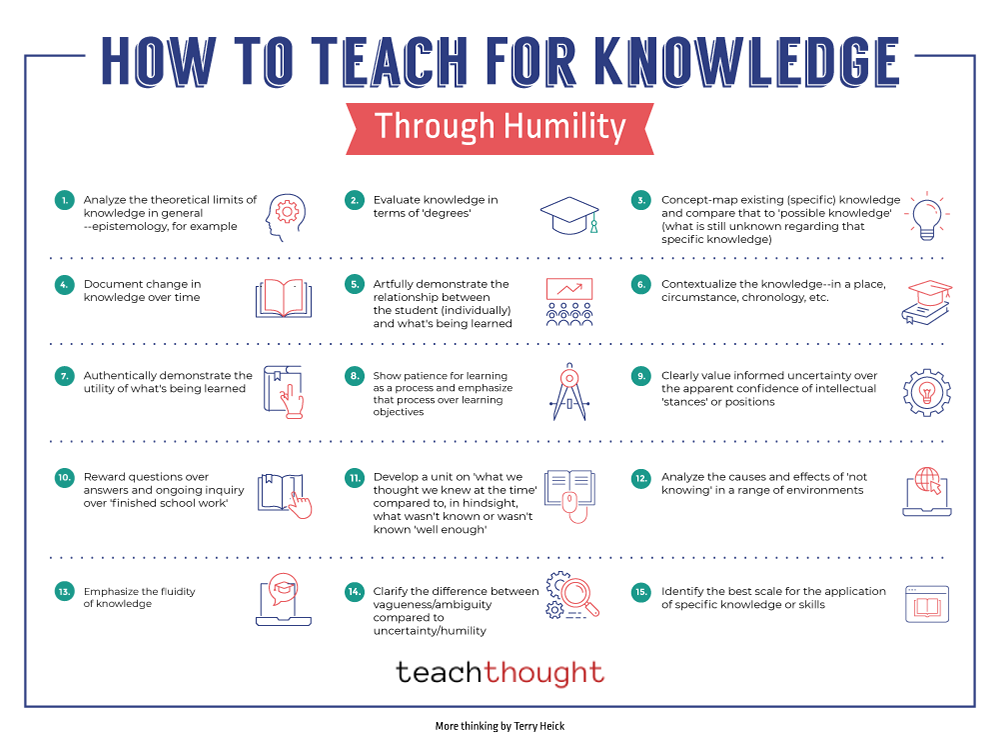
What This Resembles In a Classroom
- Analyze the limitations of knowledge in simple terms (a basic introduction to epistemology).
- Examine knowledge in levels (e.g., particular, likely, possible, unlikely).
- Concept-map what is currently recognized concerning a specific topic and contrast it to unanswered concerns.
- Paper how knowledge modifications in time (individual discovering logs and historic photos).
- Show how each student’s point of view shapes their connection to what’s being discovered.
- Contextualize knowledge– place, situation, chronology, stakeholders.
- Demonstrate authentic utility: where and how this expertise is utilized outside institution.
- Show persistence for learning as a process and stress that procedure along with purposes.
- Plainly worth enlightened uncertainty over the self-confidence of quick conclusions.
- Reward continuous questions and follow-up investigations more than “finished” answers.
- Produce a system on “what we thought we knew after that” versus what knowledge shows we missed.
- Evaluate domino effects of “not recognizing” in science, history, public life, or daily choices.
- Highlight the liquid, progressing nature of understanding.
- Distinguish vagueness/ambiguity (absence of clearness) from uncertainty/humility (recognition of restrictions).
- Identify the very best range for applying certain knowledge or abilities (individual, neighborhood, systemic).
Study Keep in mind
Study reveals that people who exercise intellectual humility– wanting to confess what they don’t understand– are a lot more open to learning and less most likely to cling to false assurance.
Source: Leary, M. R., Diebels, K. J., Davisson, E. K., et al. (2017 Cognitive and social functions of intellectual humbleness Personality and Social Psychology Bulletin, 43 (6, 793– 813
Literary Example
Berry, W. (1969 “An Indigenous Hillside,” in The Long-Legged House New York: Harcourt.
This idea might appear abstract and level of place in progressively “research-based” and “data-driven” systems of understanding. But that becomes part of its value: it aids trainees see expertise not as taken care of, yet as a living process they can join with treatment, proof, and humbleness.
Teaching For Expertise, Learning With Humility